01 Jun, 2026
Picture this scenario: You have finally purchased your highly anticipated electric vehicle (EV) and taken it out for a long, enjoyable drive. When you pull up to a public station to replenish the battery, you are suddenly met with an unexpected shock—the station only provides an open socket without a tethered cable, or the available plug is completely incompatible with your vehicle’s port (whether it is a Chinese import with a GB/T standard or a US import with a Type 1 standard)! In that exact moment, your driving excitement evaporates, and you realize that the most critical link between you and absolute driving freedom is choosing a certified and compatible electric car charging cable.
With the rapid expansion of the electric mobility market across the Middle East, buying a high-quality cable is no longer just a secondary accessory—it is the essential tool that ensures rapid charging speeds and complete safety for both your vehicle and your property.
In this professional, detailed guide from the Plugy EV platform, we will walk you through everything you need to know to select the best electric car charging cable for your vehicle, how to differentiate between various formats, and how to avoid counterfeit products that can permanently damage your vehicle’s expensive battery pack.

Most automotive manufacturers equip new vehicles with a basic emergency charging cord, commonly referred to as a "granny charger." This wire is engineered to run on standard domestic 220V household sockets at a low current draw that does not exceed 10 Amps. Depending on this option as your primary charging source means you will need nearly 24 hours to fully replenish a medium-sized battery pack!
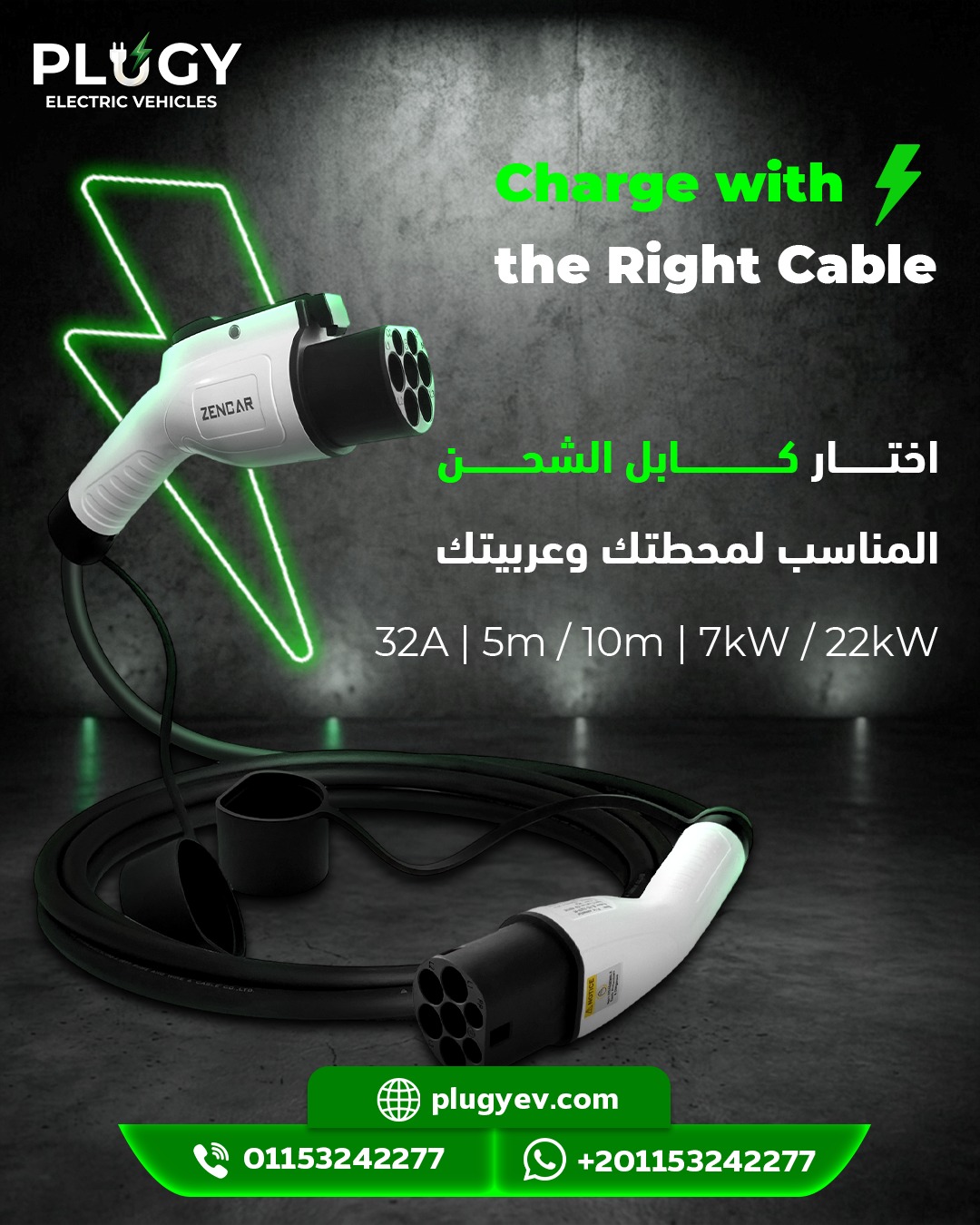
Consequently, searching for a professional electric car charging cable that supports higher current capacities (such as 32 Amps) becomes an absolute necessity to unlock your vehicle's true performance. Whether you want to power up at home via a dedicated wallbox or use public infrastructure that requires you to bring your own wire (such as Type 2 to Type 2 or Type 2 to GB/T cables), having the right gear is non-negotiable.
The charging experience and the required equipment vary significantly depending on where your vehicle is parked. To define your precise needs, let us break down the process into two primary sectors:
Home charging is the true backbone of EV ownership, where more than 80% of all charging cycles take place overnight while you sleep. To achieve this efficiently, simply purchasing a standalone cable is not enough; it requires a foundational infrastructure step—setting up a reliable EV charger Egypt residents can count on within their private villa or residential garage.
This setup process involves routing heavy-duty, dedicated electrical lines with a thick cross-section (no less than 6mm or 10mm) directly from your main electricity meter. This ensures the infrastructure can withstand continuous high-amperage loads for consecutive hours without causing the wires to overheat.
Naturally, this introduces the core question of infrastructure installation costs. The total investment covers essential safety components, including automatic circuit breakers to protect against short circuits, dedicated earthing lines, and certified engineering labor. Investing in a proper foundational setup protects your property from fire hazards and establishes a highly stable environment for your heavy-duty electric car charging cable kit.
When hitting regional highways or traveling between major cities and governorates, you will depend heavily on national infrastructure networks. This highlights the vital importance of keeping a flexible and compatible electric car charging cable neatly packed in your trunk, allowing you to connect seamlessly to untethered public charging points.
For instance, if you travel across the Gulf region, you will notice a massive leap forward in the infrastructure layout of electric vehicle stations across Saudi Arabia, which offers ultra-fast charging points along primary highways and inside major commercial centers in cities like Riyadh and Jeddah.
At these specific stations, you typically need a flexible Type 2 cable to bridge your car to charging points that do not feature built-in cords—a standard practice implemented globally to protect public equipment from environmental damage and theft.
When browsing through specialized charging products, you will encounter various technical terms. Here is how to simplify your choices based on your goal of securing a high-speed charging experience:
If you are an avid road-tripper, enjoy camping, or simply want to eliminate range anxiety in remote locations, carrying a mobile EV charger is your absolute best defense. This hardware seamlessly combines a heavy-duty, premium-grade cable with a smart, compact control module. It allows you to draw rapid charging speeds from any standard domestic or industrial socket (such as standard blue or red 32A industrial plugs) you encounter along your route, completely eliminating the need for a fixed wallbox station.
When evaluating options, understanding market tiers helps ensure you invest in authentic hardware that safeguards your vehicle's internal components:
|
Cable Configuration |
Ideal Use Case |
Market Expectations |
|
7.4 kW Single-Phase Cable (Type 2 / GB/T) |
Perfect for daily home overnight charging on standard 220V residential connections. |
Highly cost-effective; standard baseline entry for all EV owners. |
|
22 kW Three-Phase High-Speed Cable |
Ideal for maximizing public AC infrastructure or home charging on upgraded 380V meters. |
Mid-tier investment; provides excellent future-proofing. |
|
Premium Specialty Options (e.g., Electric car charging cable tesla kits) |
Tailored for maximum reliability, specific luxury vehicle cross-compatibility, or integrated adapters. |
Premium Tier. |
🛒 Looking for reliable hardware? Avoid searching blindly for an "electric car charging cable near me" from unverified local merchants. Non-certified, bargain-basement wires can easily overheat and fry your vehicle's sensitive On-Board Charger (OBC)—the repair cost of which can easily exceed the price of an authentic cable many times over.
Read more about: how to charge ev at home

Investing in a premium-grade, globally certified electric car charging cable is your single best guarantee for absolute personal safety, vehicle protection, and time savings.
At Plugy EV, we stock an extensive selection of authentic charging cables, adapters, and portable emergency charging stations compatible with all European, American, and Chinese vehicles active in the market. Every item is backed by a genuine local warranty and comprehensive technical support led by specialized engineers.
We are here to assist you through every milestone—from designing your home infrastructure to hitting the open road with complete peace of mind. Browse our digital storefront today to secure your premium charging setup!
The standard and most practical length for daily use is 5 meters, which offers ample flexibility to reach your vehicle's charging port whether you park nose-in or tail-first. However, if you manage a large residential garage or frequently park in public spaces where the layout forces you to park further away from the station hookup, we highly recommend upgrading to a 7-meter version.
Yes, absolutely. High-quality smart cables are engineered with full backward compatibility. The vehicle's onboard management system will strictly pull the exact volume of power it requires and no more, completely eliminating any risk of electrical overload. Buying a higher-capacity cable is actually an excellent future-proof investment if you decide to upgrade to a newer vehicle model later down the line.
Your cable must carry globally recognized quality and safety certifications, such as CE and TÜV stamps. Structurally, it should be manufactured from flame-retardant, high-thermal-resistant TPU (Thermoplastic Polyurethane) insulation. Additionally, it must feature an environmental ingress protection rating of no less than IP55 to thoroughly safeguard the internal copper wiring against heavy rain and dust during outdoor charging sessions.
The structural cable standard itself does not differ, provided the physical plug interfaces match (as the overwhelming majority of public AC networks in both countries utilize the standard Type 2 outlet). The only real variance lies in local grid infrastructure developments and the specific electrical current configuration active at the station. Because of this, it is highly recommended to permanently store a flexible adapter cable in your vehicle's trunk so you are fully prepared for any socket variation across Arab nations.
Read more about:Wallbox charger